Showing posts with label ruin. Show all posts

04 June, 2014

St Dunstan in the East Garden

St. Dunstan in the East Garden
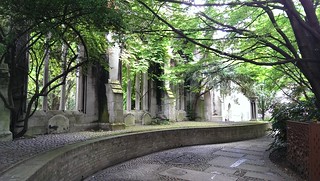
Wow...a year on and I'm *still* finding amazing little gems like this, strictly speaking this is in the City, not Wapping, as it's too far West, but it marks about the half-way point if I'm walking between Thomas More Square and London Bridge...wish I had stumbled across it before!

24 July, 2013

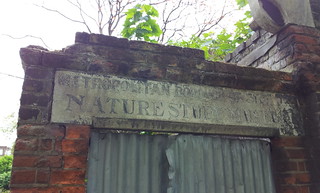
Whitechapel Nature Study Museum

Nature museum
Nature museum
Nature museum
Nature museum
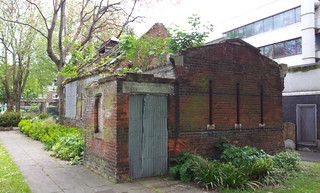
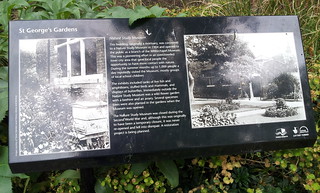
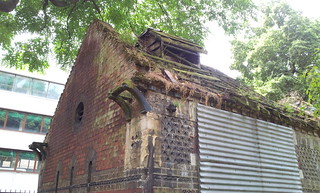
Just up the road from the office, what at first glance appears to just be a derelict shack, is actually an interesting bit of history...originally a mortuary, for many years, this building was a satellite of the Whitechapel Museum seeing up to 1000 visitors a day(!) who came to enjoy exhibits such as "live fish and amphibians, stuffed birds and mammals and displays of butterflies" (among other things)...if the sign is to be believed there is a restoration project in the planning stage... ;)  More interesting bits on it over here (including the fact that there was a resident cockerel (which was, very oddly, washed in benzol) and a monkey that had "from time to time bitten and attempted to bite not only members of the museum staff, but the general public as well"...well, forget Legoland - what fun that sounds!  Roll on the rebuilding project! ;)

29 July, 2008

Climbing Nohoc Mul - Coba - (part 4)

Coba #45
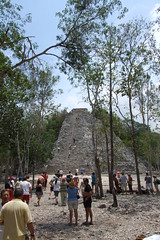
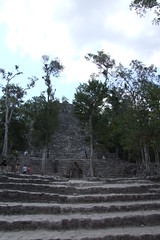
Okay, back to Mexico (btw - hit that link to see all of the honeymoon in order on a single page if you need to catch up as it's taking forever to go through all the pics) briefly now (and just to catch you up) we had just been warned - "Nohoch Mul is just ahead, you have 30 minutes, the transport will leave without you if you do not get back in time. Please keep in mind it is 40 degrees centigrade, or about 104 Fahrenheit, you will have to climb almost vertically 140 feet on uneven, slippery polished stone, humidity is close to 98% and your insurance is unlikely to cover you, so please, think carefully before you walk through those trees"...and I had turned heels and stepped towards the stones at the foot of the pyramid just visible in the distance...the trees parted (and the photo can't do it justice) our task was ahead of us...
Coba #47
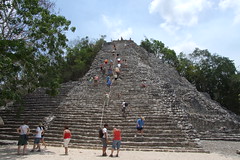
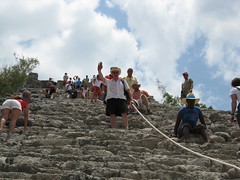
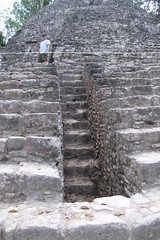
Talk about a ruin compared to "El Castillo", it's hard to imagine it ever had any right angles...each step varied in depth, height, inclination and grip by a colossal amount, sometimes a step up would be a foot and a half, onto a two-inch deep 30 degree slope of glassy rock covered in a light dusting of fesh-fesh like sand (only the creaking rope being gripped firmly with both hands giving you any hope of making the next one) -
Coba #48
- the next step would then be perfectly straight, comfortably deep and a mottled surface affording you the perfect grip (meaning you are constantly, and literally on your toes the whole time)...it took about six or seven minutes to drag myself to the area just below the top, absolutely dripping with sweat now, my clothing soaked through, fingers slick, my camera banging into my back looped around head and arm (just in case)...but actually, getting up here hadn't been too bad (I thought to myself, with a considerable amount of relief)...certainly not an exercise to undertake without total concentration, but not too bad...that was (and I'm sorry for no pictures, but both hands were used for *proper* climbing at this point) until I saw the *tiny* ledge (big enough to hold about half of my footprint) over the 130 foot drop I was going to have to navigate next...this in order to reach the final three 1.5/2-foot tall steps that also loomed over the void that had to follow...people were *very* cautiously gripping on with all their might to the top of the sheer wall (about 5 feet high) and tip-toeing along this ledge and around the corner, doing a very passable impression of Lara Croft...only one person at a time could traverse this section...I had *very* serious second thoughts (my feet are much larger than most peoples)...I pictured myself slipping on sand and tumbling off pointed rocks all the way to the bottom...I had some very deep breaths...and then some third and fourth thoughts, none of which were very encouraging either, and then (uh oh) a gap appeared in the people and I just gulped and went for it (without looking down), scrambled incredibly inelegantly up the three dusty giant stairs and there I was - standing like a Mayan Elite - on the top of the Yucatan peninsula (I've still got no idea how I managed it)...! I could have cried (had I not been petrified of falling off and completely shattered)...so I contented myself trying to stop myself shaking and carefully getting the camera off my back without dropping it to smash below...
Coba #54
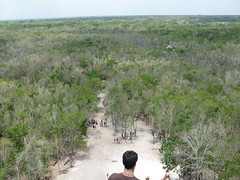
This was about as close to the edge I could get myself to take a picture (my powers of self preservation being considerable) - at the top right of the shot you can just see one of the water sources I spoke of earlier (the reason why the city is here at all), some kind soul has made a panoramic view though, which is well worth a look, but we didn't have time to be mucking around (unfortunately), next I decided to take a look in the temple on the top -
Coba #51
- with obligatory falling god above the doorway -
Coba #52
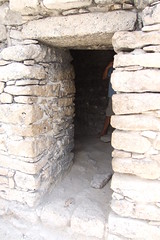
- and it was actually quite disappointing, I'm not sure what I was expecting to be there...the space was incredibly small, and absolutely nothing was inside (just about a 10 foot tall Mayan arch-shaped empty space - entrance and corridor in a T shape), just enough room for about 5 people to stand comfortably in elaborate costumes (perhaps a box or two of bottles of wine, some snacks, maybe a rack for sacrificial weapons...that kind of thing), but nothing at all there now, not even any decorations...

Anyway, starting to get breath back, it really was time to be heading back down now, had I had a choice I probably would have delayed that horrible gap as much as possible and got myself in a state, but the clock was ticking, so stashed my camera, waited my turn and then scuttled back across...turned around and took a peek at what I had to do next and absolutely reeled with vertigo...it was so steep...coming up had been absolutely fine simply because you didn't have to look at what you were stupid enough to be doing...shit! I have *never* been good with heights...what on earth did I think I was doing? I get reactions sometimes to heights when playing sodding video games...!

What can I say? Thank God for time constraints...? What choice did I have in the matter, we had to get down (although "I'll be fine, I'll just stay up here" did sort of cross my mind in a ridiculous way)...so I started to lower myself, one step at a time, perched on my arse...(at least, I thought, I am cleaning the slippery sand off the the people coming after me)...but it was incredibly slow going, my final solution was to cross (crab-like) over to the rope and then sneakily come down *backwards* (no view of bone smashing fall? No problem!) using the rope to support myself...when I got to a comfortable height (fracture rather than shatter sort of level) we paused for Flyingpops (who was having no problems at all) to take a quick snap (still about 70 feet up mind you) -
Coba #55
- and then I resumed my reverse descent until we finally reached Terra firma (and my heart-rate was allowed to return to normal)...

Jeez...did I really just do that?

We found a small stall selling ice cold water, bought and glugged down two bottles in about 60 seconds flat and then returned to where the guide was waiting (after promising each other we could get a bike back through the jungle)...he was talking as we were waiting for the stragglers to complete the climb - "So now I wish to explain to you, put the jigsaw together, how did these people rule? How did the elite control the people? It was simple, they ruled by..." and here, he hushed his voice, ducking down with a sparkle in his eye..."Magic!"...he stared directly at the little girl whose ears he had covered earlier (who looked incredibly shy and hid behind her mum)...

He smiled and stood up - "Put in your mind, these people, their heads deformed, looking not like the regular Mayan people, dressed in elaborate costumes, hidden at the top of the pyramid in the temple, word has been sent out to the people to come along on a certain day. They come, they assemble in their thousands, on this particular day the sun rises directly behind the pyramid, the top of the pyramid is covered in obsidian, when the sun strikes it the gold colour in the rock bursts out at the correct moment, out step the ruling elite, it looks from here as if they have walked directly out onto the top of the pyramid from inside the centre of the sun"..! "They have used their incredible mathematics and astronomy to create this illusion, the people are in awe already, and then, thanks to the acoustics of the pyramid, their voices are boosted to a booming level, they can be heard from miles away"..."What do they say? They use their calendar to announce the movement of the moon, the timing of the next eclipse, to these people it seemed that the Gods were manifested before them! Speaking the secrets of the heavens!"...it's all suddenly so clear...there is no mystery here, the Mayans were ruled through a combination of clever science and showmanship...

...and as we paid our money and collapsed into our taxi bike my mind spinning with everything we had already seen and done it came back to me that this day had much more left to offer - on the bus (at about 8am) we had been asked to choose what we would like to eat for lunch (chicken, pork or "vegetarian") as it was going to be cooked in a pit, wrapped in banana leaves in the traditional Mayan manner (which would take 3 or 4 hours)...and then after we would be privileged enough to go and visit a real Mayan village, not a tourist reproduction, but a current living breathing settlement taking it's first faltering steps towards integration with modern Mexico (but more on that later)...

12 July, 2008

Coba - Jungle Trek (Part 3)

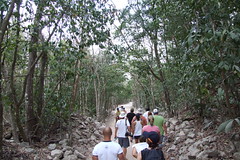
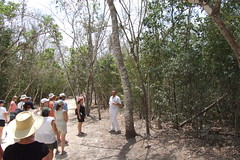
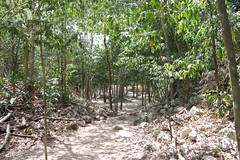
...and so off we set, sticking to the shade as much as possible (it helped, but not a huge amount), everyone was absolutely dripping with sweat (guide included) -
Coba #32
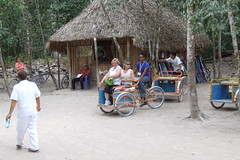
- some people sensibly decided they wouldn't be able to make the trek and hired a taxi bike (which cost 95 pesos for the round trip or about £4.60 - very reasonable) -
Coba #31
- as we staggered through the heat, so the guide would periodically pull the group together to show us interesting things -
Coba #35
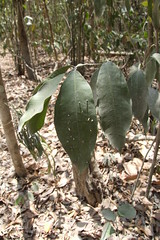
- this plant, for example, the Mayan people would pick off some of the peeling bark and chew to help with tooth ache and headaches -
Coba #33
- when scientists got hold of some and worked out what the active ingredient was, the world was given ibuprofen (Nurofen or Advil in the US)...I sneakily pulled some off and ate it, but spat it out - nasty bitter taste - we'll keep the pills I think...this next one -
Coba #36
- he said a certain flying insect had laid eggs on the leaves, later the offspring would work their way to the interior of the tree and feed there - the tree is felled and the creamy matter left behind was used to treat diseases of the stomach - this was where the world outside found "Milk of Magnesia"...next up, something we had been waiting for, these two tiny patches of apparently white coloured mould -
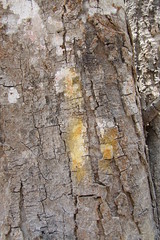
Coba #37
Coba #38
- burst into brilliant colour when the guide spat on his finger and rubbed them vigorously...this is the source of Mayan pigments (and these patches were few and far between, the amount of foraging required to colour even a tiny handkerchief would be considerable)...next he stopped us by a very sorry looking stick (with one tiny leaf just peeping out the top) -
Coba #40
- this, he explained, wasn't surprising...it was "Salvia divinorum", an extremely potent (in fact the most potent) naturally occurring psychoactive compound known to man...specimens further from the beaten path would likely have a few more leaves... ;)

This next plant, he said, was infected with something (and actually I'm not sure I needed him to tell me that), the wound that was still bleeding (two weeks later) on his hand occurred when he accidentally brushed against just such an infection during an earlier tour (suffice it to say we kept our distance) -
Coba #34
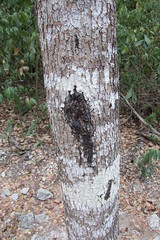
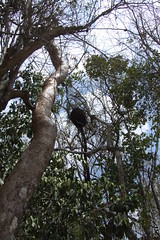
A short distance along the path, our attention was directed to a dark mass up in the trees, this is said was another signal used by the Mayan people to predict severe weather, the termites apparently have a sixth-sense for severe weather conditions and up-sticks (literally) the entire hive into the branches (quite why I'm not sure, maybe to be closer to their food supply), if people noticed new hives appearing up in the air, it was another clear signal bad times were neigh and to make sure everything was securely tied down...
Coba #44
Later we passed a funny looking tube, sticking out from a tree trunk, some people pointed at it and the guide ran in, looking very closely it was possible to see tiny (about a third of the size of UK bees) Mexican bees sitting inside (it was safe to go near, we were told, as Mexican bees have no sting) -
Coba #43
- so I took a macro shot while they patiently put up with my lens blocking the entrance (we hadn't noticed a single flower the whole time we had been walking, so they probably didn't have too much to do anyway)... ;)

The rest of the walk was conducted as quickly as we could, considering the conditions...we walked over one of the "sacbe" (the raised, white walkways that connected the various Mayan cities that we learned about when we visited Tulum), but it was now just a (many kilometre long) bump in the ground, completely overgrown...we passed the entrance to the other ball court (which was in a considerably worse state than the one we had seen already, so we skipped it)...Oh and noticed one thing the guide didn't point out -
Coba #46
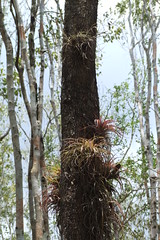
- some Epiphytic plants (called "air plants" in the UK) living comfortably without soil while hitching a ride on a rather taller cousin...funnily enough, extracts from these plants are used to make most common hay fever remedies (lots of medicine in the jungle)...

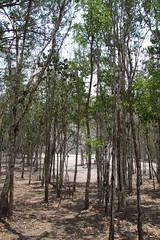
We pulled up into a huddle in an area of tiny trees just a little way further on and the guide settled everyone down, and then said "Nohoch Mul is just ahead, you have 30 minutes, the transport will leave without you if you do not get back in time. Please keep in mind it is 40 degrees centigrade, or about 104 Fahrenheit, you will have to climb almost vertically 140 feet on uneven, slippery polished stone, humidity is close to 98% and your insurance is unlikely to cover you, so please, think carefully before you walk through those trees"...

I took a peek through the trees to the base of the largest pyramid on the peninsula, greater even than El Castillo at Chichen Itza but in a state of terrible ruin...Flyingpops turned to me and said "Are you going to do it?"...I fixed my gaze, reeling slightly with anticipation of vertigo, gritted my teeth and then strode purposefully towards the bottom step...

No way was I coming all the way to Mexico and not climbing to the top...

09 July, 2008

Coba Mayan Ruins - a walking tour - (part 2)

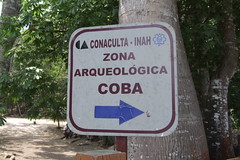
...and so we pulled into the car park at Coba, the difference to the other site we had visited was pronounced, this was basically still in the middle of the jungle -
Coba #8
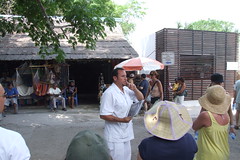
- our guide handed out water, took people to pay camcorder tax (blah blah blah), warned us that the walk was very long (4km to the main pyramid) and that in the jungle we were to make sure we touched *nothing*
Coba #9
- showing us a wound on his hand where he touched a tree by accident, it had been two weeks now, and the bleeding still hadn't stopped (ulp!) -
Coba #10
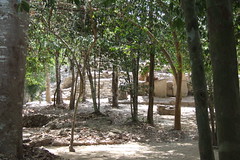
- and then in through the "entrance"...trees proving rather difficult to avoid, being pretty much everywhere, on the other sites we would (by this stage) have been walking on well bordered paths, not so at Coba, the archaeology is still going on -
Coba #12
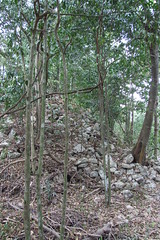
- believe it or not, this pile of rubble is actually what a lot of Chichen Itza looked like when the archaeologists first arrived, seeing the ruins in this untouched condition the plant-life they have removed and the jigsaw puzzles they have then solved are all the more impressive, the reason why this site is so overgrown and in comparatively poor condition is that it was only *really* examined in any detail by archaeologists in 1926, and serious work on the site only started in the 1970s (so you can really get a feeling for what it would have been like, spotting the mysterious piles of stone for the first time off in the jungle as an early adventurer - pretty exciting!) -
Coba #11
- anyway, we picked our way carefully through the brush, stopping briefly for our guide to draw a map of the site in the sand and tell us the built up area here is the largest in Yucatan at around 80(!) square kilometres (about the size of Plymouth), it sprang up here because of the proximity of two huge fresh water lagoons (and three smaller ones), the lands all around the city were an agricultural centre...estimates for the number of city dwelling inhabitants seem to put the elite at around 55,000 strong, with an unknown (but probably significantly greater) number of agricultural workers working the lands around...first stop proper was the Coba Group complex, starting with the main pyramid -
Coba #14
- the revelation here being that the archaeologists did a bit of digging (as this site was a bit of a state anyway) and discovered what was underneath the pyramid, the answer? Another pyramid -
Coba #16
- it was explained that the Mayan's used their amazing powers of mathematics to work out (and I think it was on a 22 year cycle, but I could be corrected on that number) when it was time to add another layer onto the pyramid, so not just one pyramid but many, many pyramids, each more impressive than the one before (in order to appease the Gods)...another amazing feature of *this* pyramid are the grooves cut in this one side -
Coba #20
- the guide explained that when the (annual) great storms threatened as the winds start to pick up so these channels in the side set up a resonant hum, warning the residents in good time (in and no uncertain terms) that now would be a good moment to tie everything down...they had also uncovered a few tunnels -
Coba #15
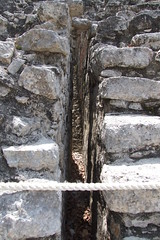
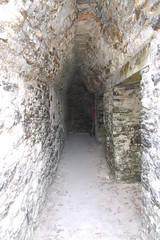
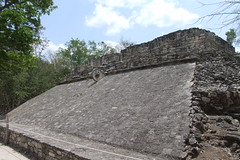
- eating into the base of the pyramid, but there wasn't a lot to see down there (a few very dark, tiny, empty rooms)...from here we made our way to one of the two ball courts (the best preserved one) -
Coba #22
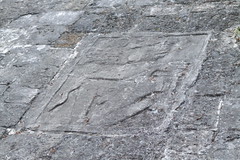
- where our guide showed us a very interesting carving (you will want to zoom right in, which may mean logging into Flickr/Yahoo!) -
Coba #29
- here he showed us (and it's very clear) the elongated head - the physical sign of the ruling elite (and here the rep reached out and turned a little girl's head away and then covered her ears, whispering to the adults), in his hands a blade, between his legs his erect penis, and he has used his knife to cause a river of blood to pour from his member to fertilize the land. The thought being, two teams of elite played this game (*not* sitting on high watching - actually playing) fighting for the honour (by thrusting the ball with their hips, aiming to get it through the circular opening) of being the one who has earned the right to give the divine blood from his penis to guarantee the rains and harvest...puts rather a different perspective on it, doesn't it...? Being a farmer looks a bit more attractive now... ;)

The last thing we were shown here, before starting the trek proper through the dense jungle were the skull carvings -
Coba #25
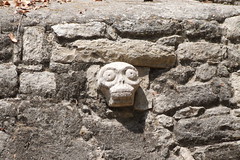
- not with hollow eyes, but staring - a sign, he said, that these people found no fear in death as they believed in life after...

All incredibly interesting, but there was much, *much* more to come...

08 July, 2008

The Road to Coba - (part 1)

Back to Mexico (I know, I know, but that many photos take a *long* time to go through, and besides, Flyingpops *still* hasn't written about the Dolphins yet, and I'm nearly at the end of the holiday now, so actually I'm being very quick, comparatively)! This day was *so* packed with information and experience I'm going to be forced to chop it into bits, so just to start with, a little about the journey to Coba...This pick-up was an *absolute* *nightmare* so early that as the main restaurant doors were being unlocked we were barging in, nearly knocking the Maître de off her feet, grabbing a quick bagel with Swiss cheese and butter turkey (for me...oh how I miss American butter turkey...) and loads of watermelon and cereal bars (for Flyingpops) and then we were running for main reception...of course the coach was late, so we sat puffing and panting for about ten minutes, occasionally checking the various coaches that *were* arriving (and being disappointed), until ours finally pulled in, we got on and then spent an hour touring around all the other hotels on the peninsula (Flyingpops turning an increasingly nasty shade of green each time we went around another vuelta in the road), finally finishing up having to get off the coach and wait for another one (about a 20 minute wait, but at least Flyingpops had a chance to return to a normal colour)...some people were getting really quite angry by this stage and were making a lot of fuss about it (which actually worked in our favour later on), but for now was actually a bit annoying and wasn't achieving anything...Flyingpops took a travel sickness tablet and by the time the coach turned up and we clambered on it only took about 10 minutes and she was fast asleep, leaving me to enjoy the hour long DVD about the discovery of the secret passage that led to the burial chamber of Pacal the Great (the engraving on his tomb lid being one of the straws clutched at by Erich von Däniken when writing "Chariots of the Gods")...

Flyingpops woke up just in time to watch the end credits and listen as our guide began his extremely lengthy evangelical lecture on behalf of the Mayan people...it turns out that the Mexican economy currently relies almost entirely on oil, however even the best estimates give them only another 11 years of useful pumping with which to sustain the country...a bit of a problem...they are therefore following in the footsteps of several of the Arab nations and taking the country through the process of forced globalisation and a massive career change to tourism as the primary source of national income...a couple of minor issues with this - huge sections of jungle are being sold off to developers (for a pittance) in one extreme example, when they bagan surveying the land (with helicopters equipped with heat seeking cameras) they discovered 11 thousand people that no-one had any idea were there, living quietly and simply off the land, minding their own business...the other thing is that Mexico, while being "officially" predominantly Spanish speaking actually has 62 "official" recognised languages...16 million people (that are known about) while they may have a bit of Spanish, certainly don't speak it as their first language, and many don't know any at all...so when the jungle is concreted over and littered with sun beds and pool bars, what is to be done with all these people? It's a huge challenge...apart from the obvious (a lot will be needed to clean rooms, wash millions of bed sheets, adjust acidity levels in pools, feed and water countless foreigners), many of the native people are filling unexpected gaps - suddenly a huge number of wooden hotel room doors are needed (for example)...but a lot of people are going to be left over, their homes destroyed, many unable to communicate with landowners and potential employers...

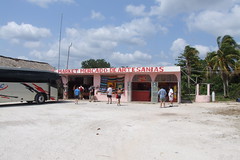
He kept speaking as we pulled into a little gift shop for a comfort break (and I'm *sure* we stopped here as another lesson) -
Coba #3
- telling us not to bother picking anything up right now, we would be back later -
Coba #1
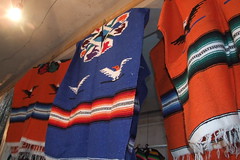
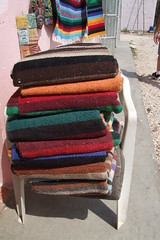
- as we piled back onto the coach he pointed out a couple of things - did we know (he asked) that ancient Mayan people knew how to make and insert silicone breast implants? He pointed at some blankets -
Coba #6
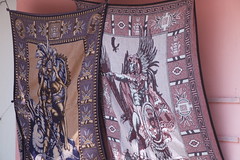
- did we *really* think these were made locally? How many people around here had we seen that looked like those pictured on the blankets? Anyone even vaguely like Pamela Anderson or Arnold Schwarzenegger? No - everyone here, he said, is short, slightly overweight with black hair and deep brown skin - these blankets had come in from China, designed by people who had no idea what they were doing, as had much of the other tourist tat - and it had *nothing* to do with the Mayans (past or present)...very little was helping the *community* to adjust and survive, just one local, buying cheap from China and making money for themselves, not helping out the Mayan people as a race at all...and as such, was frankly an insult...
Coba #5
...the guy that bought these locally made blankets to market had not only helped himself, but he had helped his neighbours too...

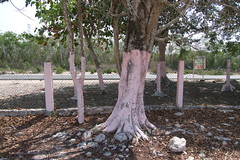
What was the Mayan's idea of beautiful? Certainly not polyester pictures of imaginary muscled warriors...He pointed to the trees, the fence posts, even to rocks by the roadside -
Coba #2
- colour (pigment) is difficult to get in the jungle, he said he would show us just how difficult later in the day, but this simple effort with a cheap can of undercoat, that was the height of sophistication...to these people, appearance is all, status symbols are terribly important, as we drove onward through villages he pointed over and over to brick or concrete buildings (only one or two rooms) laying completely empty while the Mayans happily conducted their daily business and slept in traditional hammock in the rickety structures behind them (the concrete buildings there only because they have to keep up with the Mayans, as it were)...

And so, he said, he gave up a lot of time to working with these displaced people (in a charitable way)...educate them, teach them Spanish, give them a useful trade (teaching them how if necessary, throwing in a Victorian a sewing machine if possible) and allow them to transit, as gently, but also as quickly as possible to the new (new) Mexico they are about to find themselves in. Not only that, but teach them to support their community and also find a *proud* position as a modern "Mayan".

Before I came to Mexico I thought the Mayan civilization had ceased to exist and the people were dead...how much had I learned already? There is a lost people here - lost identity and pride, marching with their heads bowed towards the edge of oblivion...just staggering...

05 June, 2008

A visit to Tulum

Tulum #1
Another painfully early start this one (quite unfairly) as Tulum was only a short way away (as the Psittacidae Ara Macao flies), but we'd opted for a half-day (our visit to Chichen Itza having been a bit of an epic) so getting up early was part of the deal...in retrospect we probably should have got a cab (would have been quicker and cheaper), but we hadn't discovered that fact at this stage...anyway, the coach finally dropped us off in Tulum (the nearby town has the same name as the ruin) in a half derelict single storey shopping centre, only the stores on the outside had survived, blocks and blocks of empty space, signposted by faded, cracking paint signs pointing to long ago deceased "Pizza y Hot Dog", "Fresh Burger" and other failed tourist amenities, only "el Banos" remained with working electric light-
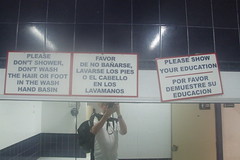
Mexico #219
- complete with hilarious sign asking those that were in need of relief to (please) demonstrate their level of schooling while doing so (but there was no attendant to enforce it, so I quickly muttered "one plus one equals three" and scuttled out guffawing at my naughtiness) -
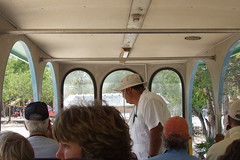
Tulum #2
- we boarded the (undisguised) tractor-driven "Wally Trolley" (having been warned that it was quite a walk from here to the site entrance) and it whisked us past more busy roadside shops -
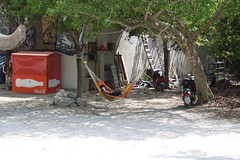
Tulum #3
Tulum #4
- (and it was actually quite a long way, so we felt justified in our laziness) and then we arrived at the main entrance -
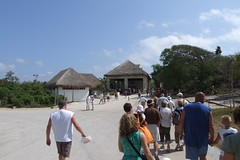
Tulum #5
- here, while we waited for the walkers to catch up and the people with camcorders to pay their taxes at the office (yeah, you don't just pay your tax once, it's a fresh payment every time you approach anything interesting)...
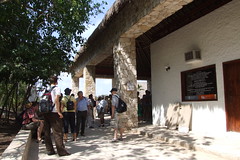
Tulum #8
Just inside the entrance our guide stopped us to point out a "Ceiba" tree (called "Yazche" or "wacah chan" by the Mayans) -
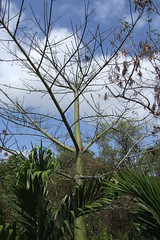
Tulum #13
- he explained that this tree was worshipped as a "tree of life", they planted them at compass points outside their cities, but this one was probably a descendent, being both not on a compass point and rather small (they can get absolutely enormous), the spreading branches represent the heavens (stars etc.), the trunk (typically they swarm with insects) represents the earth, those living on it and it's stability -
Tulum #14
- (and very spiky it is too), and the roots represent the underworld and death, very nice...Anyway, we followed the outside wall for a long way -
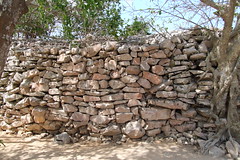
Tulum #18
- until we came to one of the four (deliberately small) entrances to the site (each of them are simple Mayan arches) -
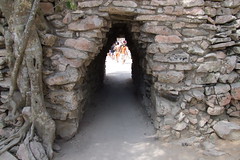
Tulum #20
- here we stood for a while, as the guide told us quite a lot of interest - This was an important trade port, the wall was a deliberate fortification (with watch towers on each corner) -
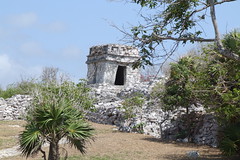
Tulum #23
- protecting the elite ruling class who dwelt within, the Mayan Arch deliberately small (to limit the number of foe that could enter at one time).

The main trade route from here cut it's way through the jungle, straight as an arrow (you can see where they got their modern road-building habits) to Coba (more on that later) and from there other (similar) paths linked up with Chichen Itza and other smaller sites. These roads were well constructed, consisting of several layers, the uppermost being crushed shells or coral rendering the surface completely white, from this the conclusion is that the movement of goods was conducted mostly at night (it being easier to lug stuff around when it's cooler and less humid) meaning the road needed to be clearly visible by moonlight...and then it was time to risk banging my head to enter the city itself -
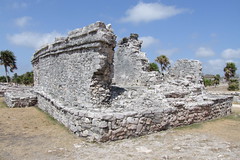
Tulum #24
- (phew!)...Next, we stopped at one of the first dwellings (on a very low step, and Tulum is right by the ocean, further evidence to debunk the "flooding" theory we were fed at Chichen Itza). It was the house of a minor noble or a respected warrior. Most interesting here was to spot the pigment still *clearly* visible on the steps (the red house at Chichen Itza being only a little bit red by now, comparitively)...
Tulum #25
Here we learned that Tulum was still being actively used by the Mayan elite at the time Cortez (the first of the naughty conquistadores) arrived. The poor natives having never seen anything like a fully decorated white European (one previous Spanish shipwreck did happen but most of those poor souls were used as novel sacrifices by the various tribes), honestly thought that one of their gods, who looked similar, had returned from the sea (as had been foretold in their holy writings) - the Spanish, of course, did little to correct their honest mistake, smiled, traded a little and then returned to Cuba gushing with tales of a huge untapped source of silver and gold ripe for the plucking, even though it was *actually* extremely rare in the area. Their enthusiasm was obviously enough of a catalyst, however, and thus began 150 years of torment for the native people of Mexico...

Our next stop was one of the extremely high status buildings, the so called "Great Palace" -
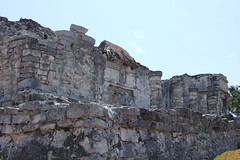
Tulum #30
- this one was obviously particularly special for one very good reason - up on the cliff there is a small temple dedicated to the "Descending God" (if you zoom in you can see him above the door doing his thing)-
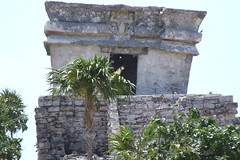
Tulum #34
- now, note the very small hole in the far wall (near the top), on a certain date each year, the sun lines up perfectly with the hole and brightly illuminates the "Great Palace" (the rest of the area being in shadow), thus transferring the power of the sun into whoever it was that lived there...powerful stuff, even though calculated, it would have seemed akin to an act of God for the lowly...next we stopped off at the "Temple of the Frescos" -
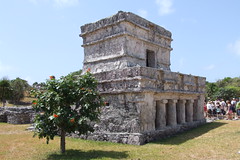
Tulum #36
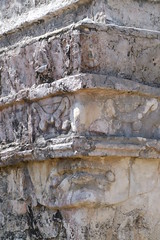
- on each of the front corners you can clearly see a face carved into the wall, one is awake -
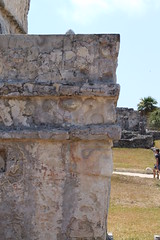
Tulum #48
- and one is asleep -
Tulum #41
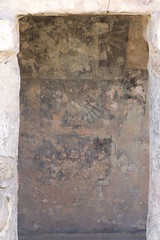
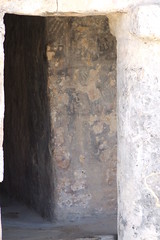
- inside it is almost impossibly small (and according to the guide this is again deliberate - "when worshipping the Gods it *shouldn't* be easy or straightforward and also to enter is itself an act of penitence, you bend to visit the Gods house"), amazingly here you can still clearly see painted murals and other signs of decoration -
Tulum #46
Tulum #47
Tulum #45
- we also learned a very peculiar thing about the Elite, which was going to form a part of a mental jigsaw puzzle that would be completed during our visit to the ruins in Coba, and that was that the ruling Elite used to deliberately change the shape of their children's heads by using wooden moulds and cords to massively elongate it (picture White Egyptian Pharaoh crown, but being your actual skull)...anyway, here the guide left us, so we went exploring the rest of the site -
Tulum #37
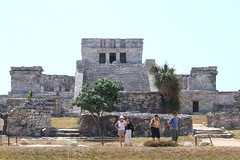
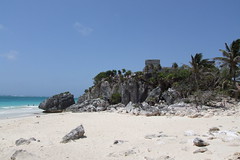
- including the imaginatively named "Main Temple Castle" and the staggeringly beautiful coast below -
Tulum #53
Tulum #56
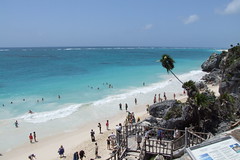
- in the distance, where you can see the breakers out at sea, this is where the waves are hitting a coral reef -
Tulum #64
Tulum #66
- Flyingpops went for an impromptu swim (not many archaeological sites where you can say that, and this was now the *second*, out of two) -
Tulum #67
- and, refreshed, we braved the heat of the day and headed back to meet the coach (the pool beckoning)... ;)